A controlled deployment of 279 iGaming sites across 17 brands, built on drop domains and powered entirely by dvig.ai platform automation. This case study documents the launch methodology, A/B-tested link building strategies, and conversion outcomes.
The deployment had four objectives: validate new brands for traffic potential, assess the competitive landscape on established branded queries, measure the effectiveness of a canonical subfolder architecture, and test two PBN link placement hypotheses under controlled conditions.
Navigation
- Approach
- Deployment Overview
- Overall Launch Performance
- Brand Performance
- Link Strategy Results
- Ranking Speed
- Traffic Quality and Revenue
- Conclusions
Approach
The launch was designed as a structured experiment, not a blind rollout. Link placement was split 50/50 across two independent axes, each testing a distinct hypothesis:
Hypothesis A: where does the link point on the target site? Half the sites received links pointing to the homepage. The other half received links pointing to the canonical money page (a subfolder).
Hypothesis B: where is the link placed on the donor site? Half the sites received links from donor homepages. The other half received links exclusively from inner articles.
Each hypothesis arm contained approximately 139 sites.
One important methodological note: all sites were built on drop domains, and the drops were selected with comparable legacy backlink profiles to minimize the noise that residual link equity introduces. A perfectly sterile experiment with drop domains is impossible by definition, since legacy always adds variance. But selecting domains with similar profiles is the closest approximation available, and it meaningfully levels the comparison between hypothesis arms.
Deployment Overview
- GEO: RU
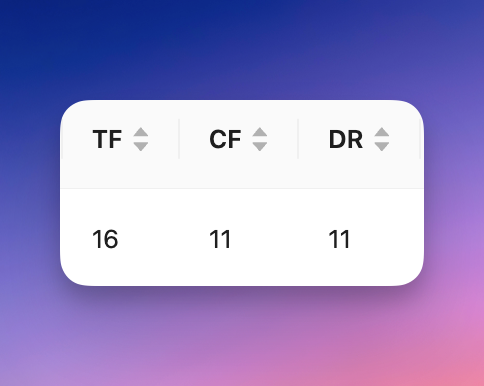
- Total sites deployed: 279 (all on drop domains)
- Brands targeted: 17
- Sites per brand: ~16
- Money page type: canonical subfolder
- PBN links per site: ~20
- Link source: exclusively internal PBN
- Offer type: cross-brand
- Hypothesis split: 139 / 139
The rollout was spread across one week to stagger indexation and keep the deployment pattern natural. Net execution time for all 279 sites, including domain setup, content generation, and deployment, was approximately 2 hours. The rest was wait time between batches, handled automatically by the platform’s scheduling engine.
Overall Launch Performance
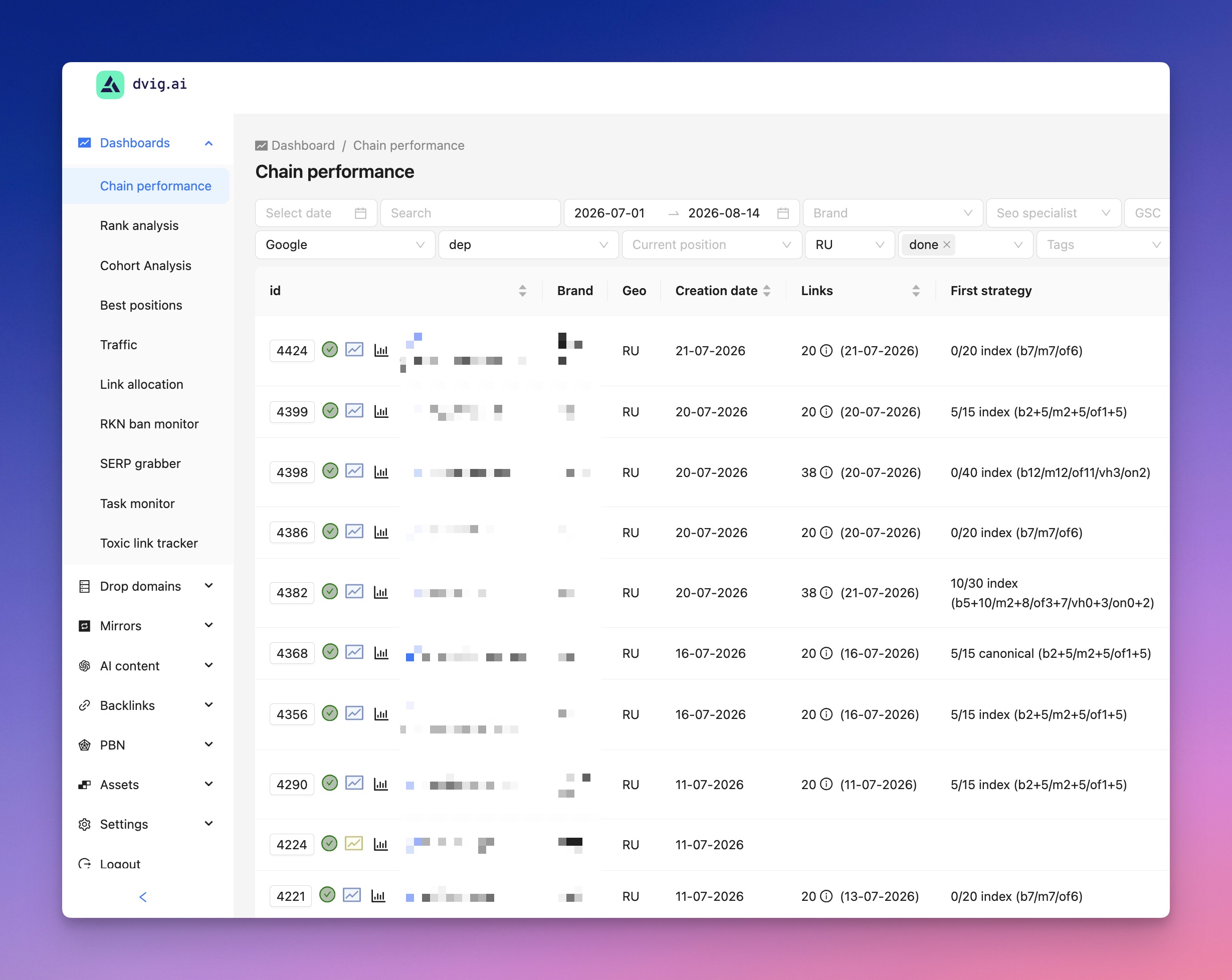
- Total sites: 279
- Sites reaching top 10: 58 (20.8%)
- Sites generating registrations: 35 (12.5%)
- Sites generating deposits: 13 (4.7%)
Context matters here: this was an exploratory launch designed to gather initial conversion data and gauge live competition. Three brands produced zero results entirely. Narrowing future deployments to validated brands and optimized configurations would push these conversion rates higher.
Brand Performance
- Total brands: 17
- Brands with registrations: 14
- Brands with deposits: 10
Two brands accounted for roughly 30% of all deposits. Beyond that concentration, deposit distribution was relatively even across the remaining brands. There was no extreme Pareto effect, which is a positive signal: at scale, this distribution pattern supports meaningful diversification.
Link Strategy Results
Hypothesis A: Link Target on the Site (Homepage vs. Canonical Subfolder)
All sites received approximately 20 PBN links. The variable was whether those links pointed to the site’s homepage or to the canonical money page in a subfolder.
Registration outcomes:
- Links to homepage: 24 sites reached registrations
- Links to canonical subfolder: 10 sites reached registrations
- Delta: +140% in favor of homepage linking
- Statistical significance: p = 0.016
Deposit outcomes:
- Links to homepage: 9 sites reached deposits
- Links to canonical subfolder: 3 sites reached deposits
- The directional signal is even stronger, though the event count is too low for statistical significance.
Hypothesis B: Link Placement on the Donor Site (Homepage vs. Inner Pages)
Registration outcomes:
- Links from donor homepages (in the mix): 21 sites reached registrations
- Links from inner articles only: 13 sites reached registrations
- Delta: +62% in favor of donor homepage links
- Not statistically significant at this sample size, but the directional signal is unambiguous.
Deposit outcomes:
- Links from donor homepages (in the mix): 8 sites reached deposits
- Links from inner articles only: 4 sites reached deposits
- Same directional pattern.
Ranking Speed
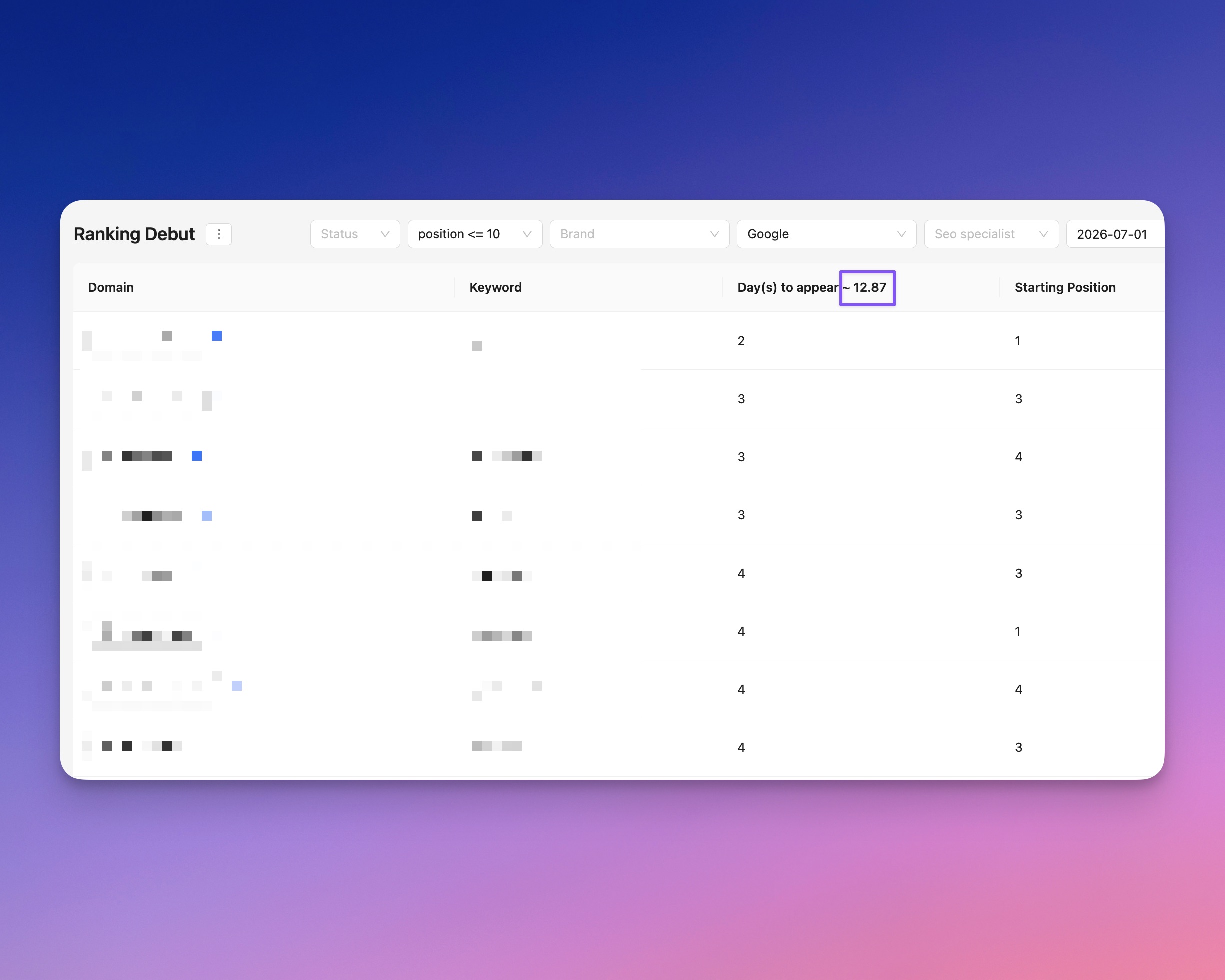
The platform’s Ranking Debut report tracks the first position and the number of days between deployment and first appearance in search results. In this deployment, sites appeared in the top 10 within an average of 13 days. The fastest result was a top-1 ranking achieved in just 2 days.
Traffic Quality and Revenue
- Click-to-registration: 6.3%
- Registration-to-deposit: 19.5%
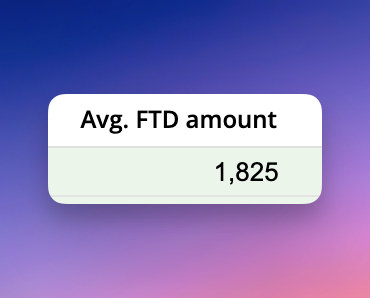
- Average FTD size: $22
- Unique EPC: $0.63
Offer Split Test
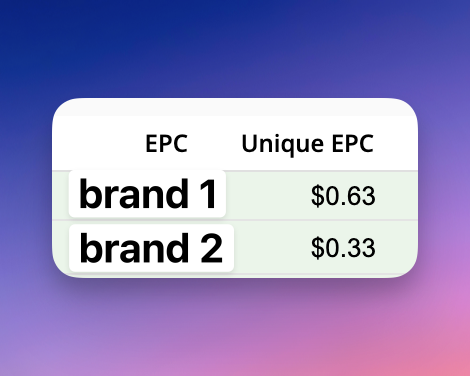
The deployment also included an A/B test between two offers: a relatively new offer and an established, widely used offer with a CPA rate twice as high.
The newer offer outperformed across every metric:
- Click-to-registration: 6.26% vs. 3.61% (+73%)
- Registration-to-deposit: 19.48% vs. 9.09% (+114%)
- EPC: $0.63 vs. $0.33 (+91%)
The higher payout on the older offer did not compensate for its lower conversion. Final profitability is a function of offer conversion quality, not headline payout rates.
Conclusions
Launch efficiency. 4.7% of sites reached deposits on what was fundamentally an exploratory deployment. With three non-performing brands removed and strategy refined around validated targets, the next iteration should deliver materially higher conversion rates.
Brand economics. 10 of 14 registration-producing brands converted to deposits. Distribution was broad enough to support diversification at scale, with no single brand creating dangerous concentration risk.
Link strategy: where you point matters more than where you place. Homepage linking outperformed canonical subfolder linking by 140% on registrations, with statistical significance. This is the clearest actionable finding from the deployment. Donor homepage placement also outperformed inner-page-only placement by 62%, directionally strong but not yet statistically confirmed.
Link quality over quantity. 20 well-placed PBN links consistently outperformed what competitors achieve with hundreds of lower-quality links. Precision in link placement compounds faster than volume.
Canonical architecture works. The canonical subfolder setup performed in line with results from prior deployments. There is no need to overcomplicate the architecture with non-standard hreflang configurations.
Stated search volume is unreliable. Several brands with Ahrefs volumes as low as 80 delivered actual search traffic an order of magnitude (10x) higher. Platform-level testing is the only reliable way to validate real demand.
Offer selection drives unit economics. The newer offer, despite a lower headline payout, delivered nearly double the EPC of the established alternative. Offer conversion quality determines profitability, not the rate card.
Full automation, single operator. The entire 279-site deployment executed automatically through the dvig.ai platform. Human involvement was confined to the strategic layer: defining hypotheses, selecting brands, and setting parameters. One SEO architect set the framework; the platform handled everything from drop domain selection through link placement. Economically, this collapses what would traditionally be a full team into a single operator. The cost per site approaches pure infrastructure cost. Scale is no longer constrained by headcount. It is constrained only by budget and the quality of hypotheses being tested.
For a look at what these deployments produce at full operational scale, see our companion case study: iGaming SEO in 2026.
P.S. One site in the deployment received zero PBN links due to an automation error that went unnoticed. It reached deposits 17 days after creation, ranking entirely on the legacy backlink profile of its drop domain. A useful reminder that domain selection is not a secondary concern in this model. It is the foundation everything else compounds on.