

Relying on domain auctions and backorder services isn’t always the optimal strategy for SEO domain acquisition. It works, and at dvig.ai we use both daily as part of the pipeline we’ve built for our clients. But competing for the same pool as everyone else is just one channel, and we’re always looking for better ways to find expired domains with backlinks – simpler, more cost-effective, and without bidding wars.
One of the directions we’ve been exploring is a web crawler we internally call Drop Harvester. We ran our first measured crawl, and the numbers are worth sharing.
Navigation
- The Idea: Find Expired Domains Through the Link Graph
- Overall Harvest
- 24-Hour Capacity
- Harvester Performance
- Where Drops Concentrate
- What’s Next
The Idea: Find Expired Domains Through the Link Graph
Most expired domain discovery starts at the registry. Drop lists, auction feeds, backorder queues – they all work from the same source: the deletion pipeline. You see a domain after it enters that pipeline, and so does everyone else. The price reflects that competition.
Drop Harvester takes a different path. Instead of watching registries, it crawls the live web and follows outbound links. When a link from an active page points to a domain that is no longer active, that domain becomes a candidate. Each candidate then goes through a multi-stage verification process to confirm it’s genuinely available for registration.
The key insight: every domain discovered this way already has at least one backlink from a live page. That’s how the crawler found it in the first place. It’s a pre-qualified lead by definition – an expired domain with an existing backlink profile, discovered without competing at an auction. In competitive verticals where domain authority determines whether you rank at all, this matters. In our recent iGaming SEO in 2026 case study, sites built on drop domains reached top-10 rankings in an average of 13 days, with the fastest result hitting position 1 in just 2 days.
Overall Harvest
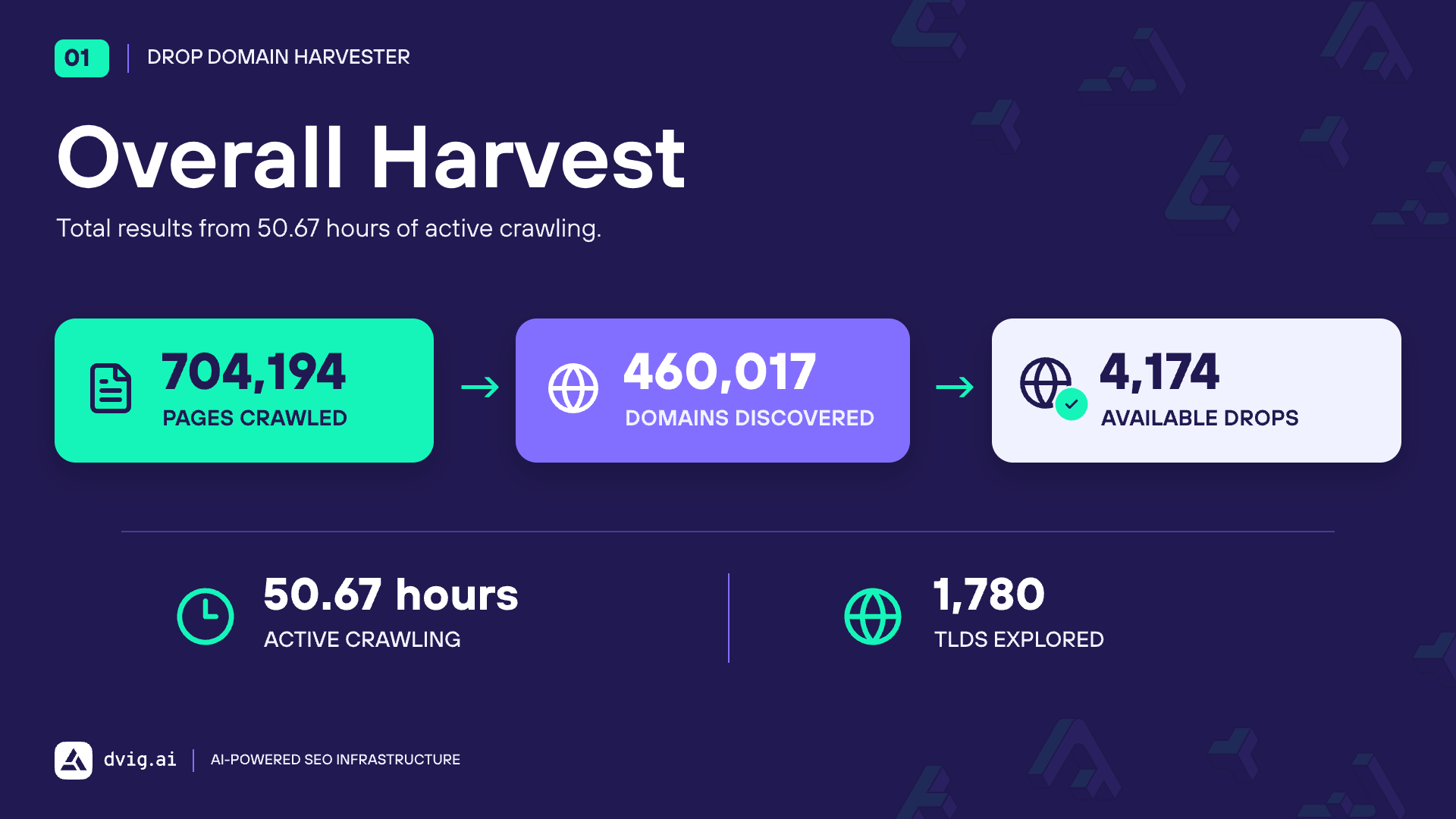
The first measured run covered 50.67 hours of active crawl time. Here’s what came out of it.
| Metric | Total |
|---|---|
| Pages crawled | 704,194 |
| Domains discovered | 460,017 |
| Available drops found | 4,174 |
| TLDs explored | 1,780 |
| Active crawl time | 50.67 hours |
The crawler processed over 700,000 pages and discovered more than 460,000 distinct domains through outbound links. Of those, 4,174 turned out to be available for registration – expired domains with live backlinks still pointing to them from the pages that led the crawler there in the first place.
24-Hour Capacity
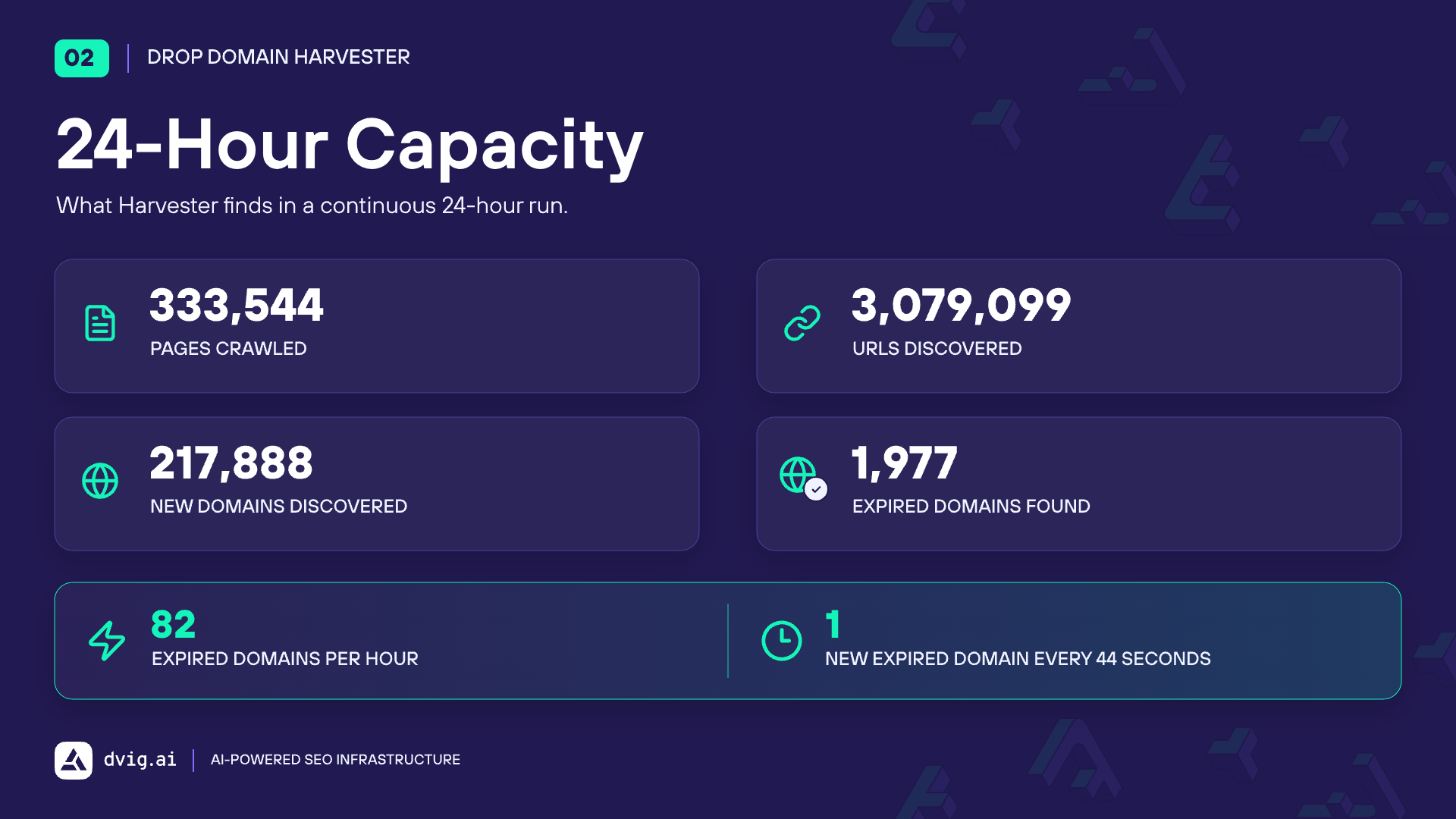
Normalizing the measured run to a continuous 24-hour period gives a clearer picture of what the crawler produces at a steady pace.
| In 24 hours | |
|---|---|
| Pages crawled | 333,544 |
| URLs discovered | 3,079,099 |
| New domains discovered | 217,888 |
| Expired domains found | 1,977 |
That’s 82 expired domains per hour, or roughly one new expired domain every 44 seconds. The URLs-to-pages ratio is roughly 9:1 – the queue grows nine times faster than it drains, which is why it’s capped rather than worked to empty. The crawler is a breadth-first machine: wide coverage beats deep crawling for domain discovery.
Harvester Performance
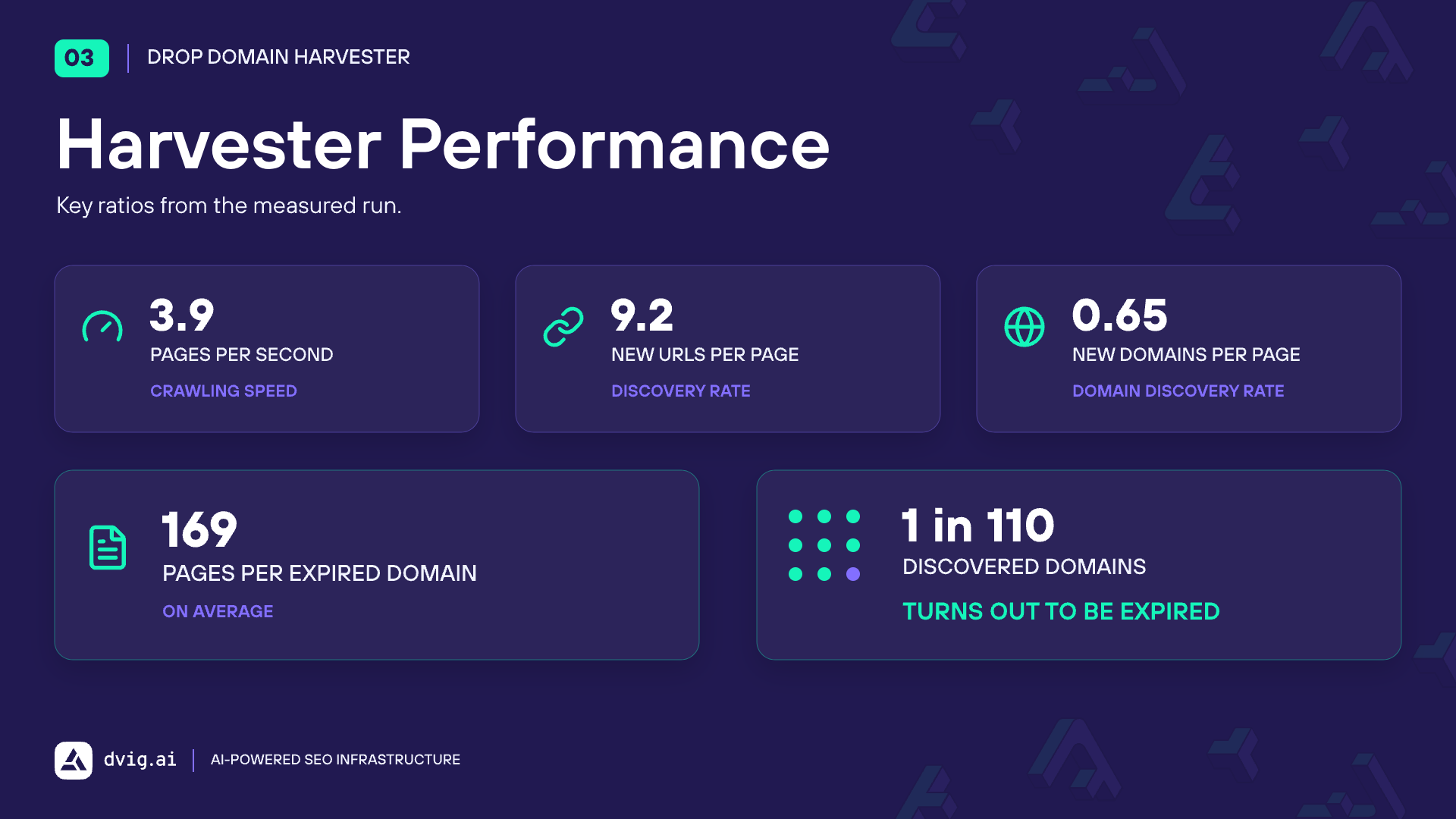
The efficiency ratios below are basis-independent – they hold regardless of how long the crawl runs and are the safest figures to quote.
| Metric | Value | Context |
|---|---|---|
| Crawling throughput | 3.9 pages/sec | Sustained average pace |
| URLs discovered per page | 9.2 | Every page opens 9 new doors |
| Domains discovered per page | 0.65 | Two pages to discover a new domain |
| Pages per expired domain | 169 | Average crawling cost of one find |
| Expired domain rate | 1 in 110 | Of all domains reached through links |
The crawler averages under 2 pages per domain. It doesn’t go deep on any single site – breadth beats depth for domain discovery. The wider it spreads, the more domains it discovers, and the more candidates it surfaces.
Where Drops Concentrate
By absolute count, .com dominates – simply because .com dominates the web. But the rate story is different.
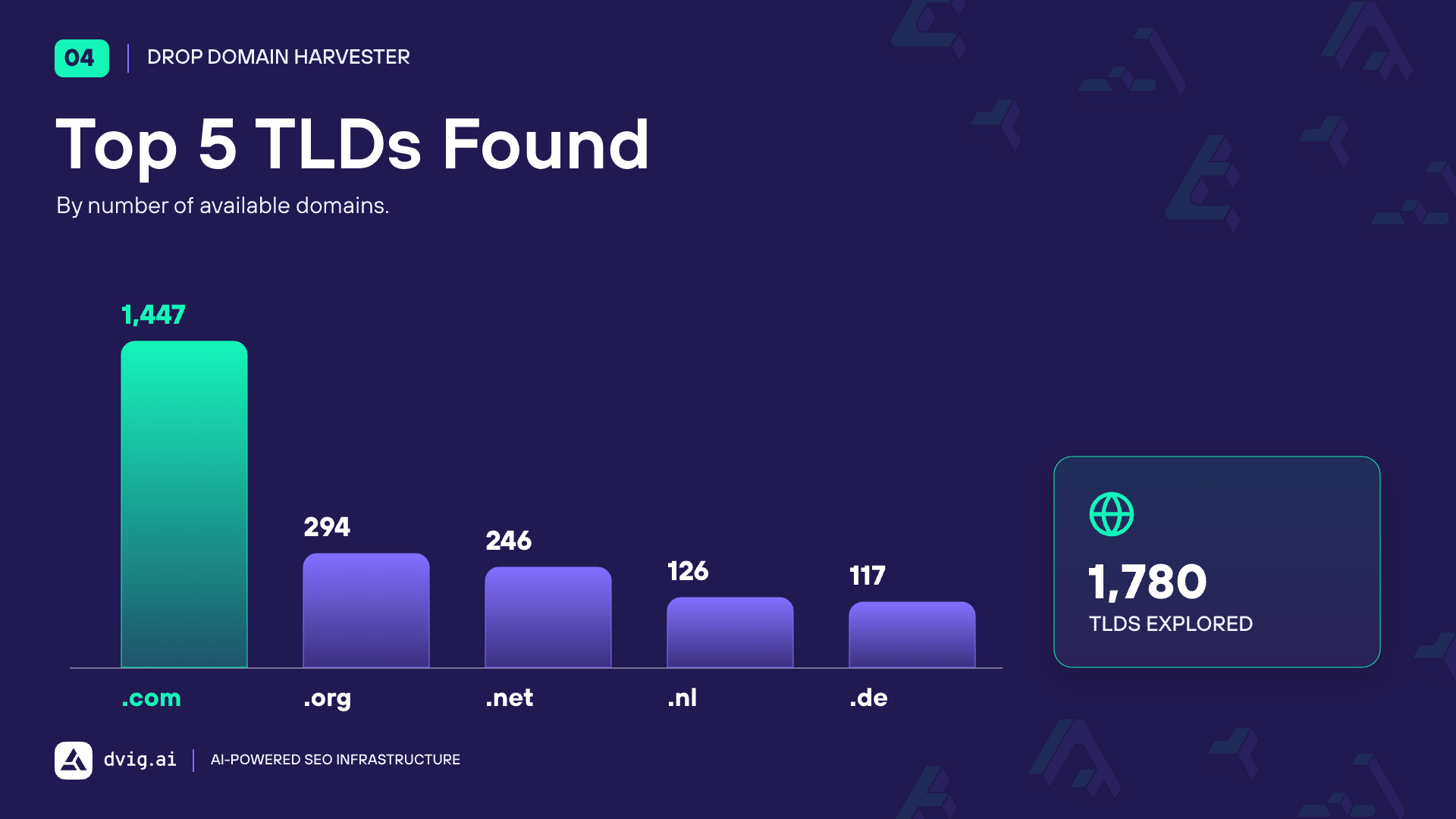
Top TLDs by volume:
| TLD | Available domains found |
|---|---|
| .com | 1,447 |
| .org | 294 |
| .net | 246 |
| .nl | 126 |
| .de | 117 |
By expiration rate, the picture is different. Cheap gTLDs like .top (5.38%), .club (5.01%), and .pro (4.17%) churn about seven times faster than .com (0.74%). Registration price predicts abandonment better than any other variable in the dataset. Volume dominates rate, which is why .com leads by count despite its low churn.
The crawler encountered 1,780 distinct TLDs across the run – a wide net that covers both the major registries and the long tail of country-code and new gTLDs.
What’s Next
This is early data from a single measured run. The numbers will shift as we tune the crawler. But the approach works.
We’re building a growing pool of available domains across GEOs and ccTLDs, so our clients can launch fast without waiting for the next auction cycle. Drop Harvester is one channel in a broader domain acquisition pipeline that also includes auction bidding, backorder services, and direct registry monitoring. The goal is not to replace any single source, but to add a discovery layer that finds expired domains with backlinks that other channels miss – domains already linked from the live web, ready to be put to work.
For a look at what we do with drop domains once we find them, see our companion case study: iGaming SEO Trends 2026: A 279-Site Deployment Case Study.
24-hour figures are normalized from the measured crawl rate. Overall totals are observed, not normalized. Performance ratios are basis-independent.